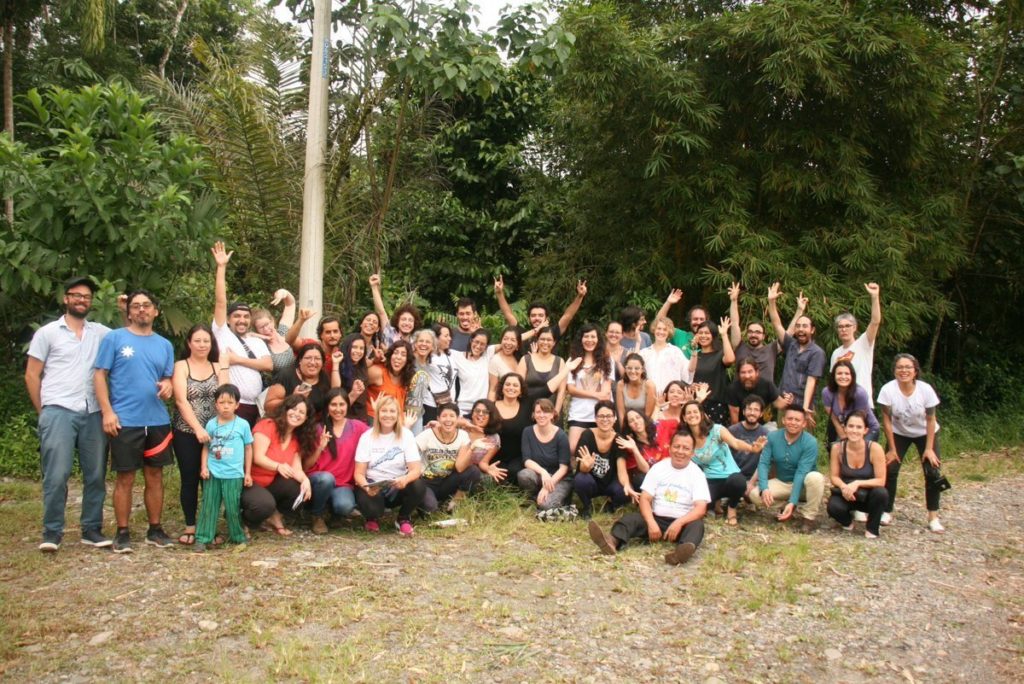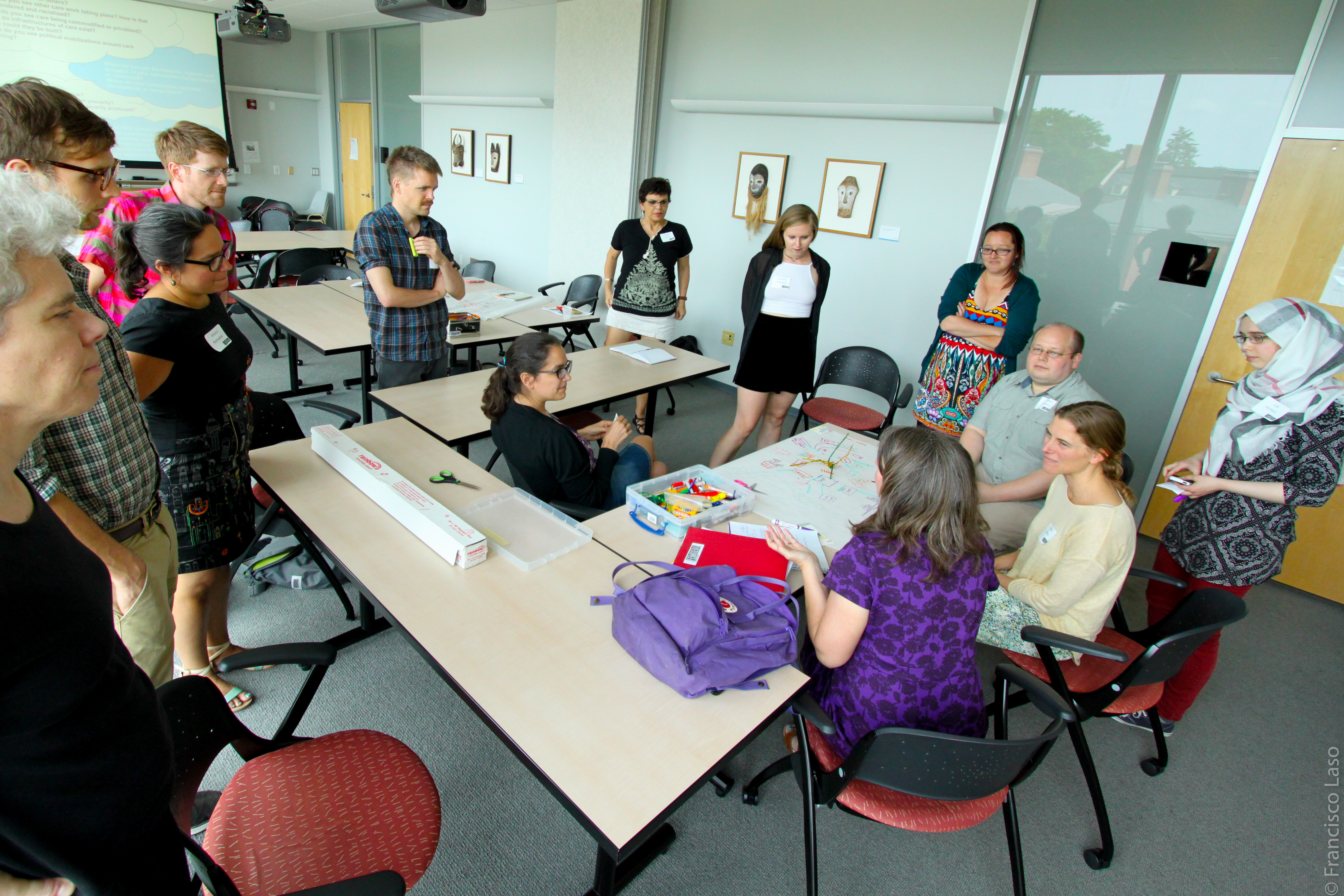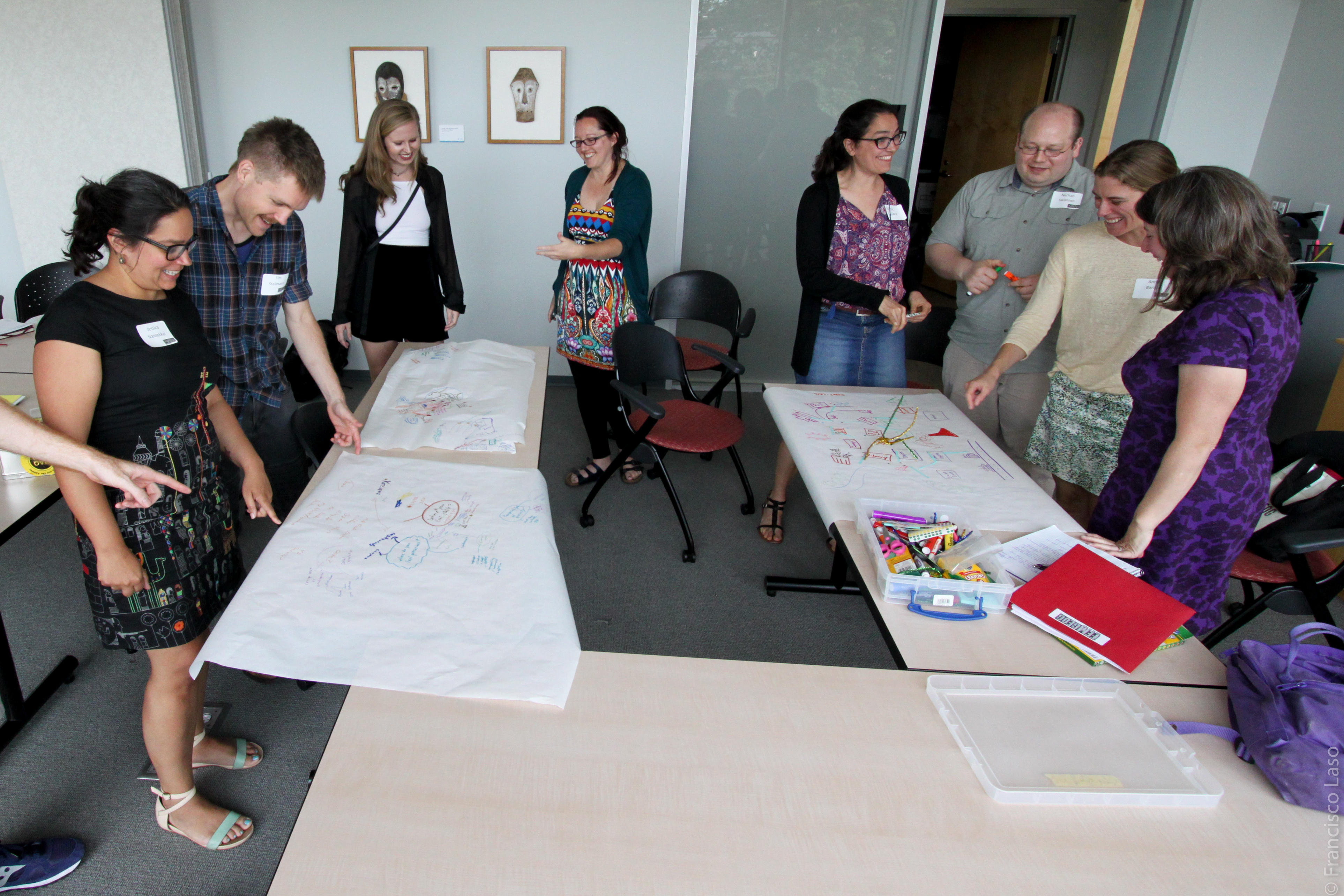
Maggie Schimitt has been in Chapel Hill/Carrboro in Nov.30-Dec.4
She fascinated us with her energy and her talks sharing the experience of Precarias a la Deriva in Madrid. Our group has been following the steps of this Madrid-based group, been always very inspired by their method of feminist/precarious derivas.
Following her advice and the Precarias a la Deriva quasi-obsession for documenting every day events and collective itineraries, we could start our blog by remembering Maggies step-to-step description of drifing and recapitulating our fist attempts of carrying on one while her stay with us. These are the different activities we did with Maggie about drifting (maybe each could be the themes for following posts):
-Brainstorming axes/themes and possible locations @ Mediterranean Deli
-Collective discussion on spaces of labor/no labor on Sundays @ Open Eye Coffee
-Step-to-Step guide for drifting & Mapping discussion @ Weaver St. Market
The 3Cs drift with Maggie Schmitt started at 3:57 PM on Sunday afternoon, Dec. 2 in a crowded Carrboro coffeehouse, Open Eye. 3Cs commandeered an unused corner of the cafe for our homebase, and started with a discussion of what themes we wanted to explore in the drift. Themes proposed were:
How much do we work (as student/in other roles)?
How much is our time worth?
Soft exploitation and self-exploitation (what forms do they take in our daily lives)
Where does UNC happen on a Sunday?
It was a rainy day, and we spent some time trying to decide what methodology to use for the drift. Should we walk to campus and visit workspaces (likely to be empty, except for lab buildings)? Visit places around Carrboro? We started off with a group interview on the question: what do you do on a Sunday? (In these notes, I’m going to include only responses, no names)
Sunday activities:
working occasionally at UNC Planetarium (funded by Union Carbide); avoiding work/trying to work at home
at home; working on the couch at a friend’s house, working at Weaver Street or Open Eye (need other people around to concentrate)
working (always at home)
Sunday morning mass, brunch with friends sometimes, working at home, phone call to parents, dinner with friends (make a point of not going to campus)
Opting to stay at Open Eye and delve further into the topics of University work on a Sunday, we started a discussion about the nature of University work, workplaces, and the intersection of social space and labour space.
Open Eye has been described as Carrboro’s living room — a place people visit to meet friends and to relax and to do work, more often all three. On the day of the drift, we counted 75 people in the cafe, and 45 laptop computers. Only three people weren’t working (or, weren’t trying to look like they were working). Work permeating the social environment to such an extent is something we realized we’d often taken for granted, and the discussion which ensued focused on the relationship between work and social space.
Sebastian: “One of the cute/destructive things about this sociality is that whenever we see each other, we’re reminded of work we haven’t done. We [married couple with a young baby] used to come to Open Eye and bring work, and it’s interesting that there’s no barrier between work and café. You only have to be at the University for so many hours, but you’re expected to do hours of other work.”
Maggie: “Things are very different in Spain”
Maribel: “Agreed”
Maggie: “Right.. work doesn’t happen in cafes, it happens in the overcrowded libraries. The whole notion of a café for workers doesn’t exist. You go to a café to hang out/smoke/drink/play cards.”
Liz: “Still, there are some benefits to having this collective space – I remember one time all of the folks in one of my seminar classes happened to be here at the same time before a big due date for a paper, and we all collectively decided not to do the assignment”
Sebastian: “But you were all anthropologists; that’s important – only certain departments come here. Lab sciences have to be physically in the lab to work, and they’re there most of the weekends.”
Tim: “Yeah, so all of South Campus [the medical/sciences complex] is busy on the weekends, while North Campus is quiet.”
Maribel: “Maybe it’s a political/cultural thing?”
Maggie: “There’s also this added value of networking – you can’t read everything but you can know enough people who have. Does this space become important as a site for affirming casual relationships?”
Tim: “It’s not just University work though. Weaver Street Market [a co-op grocery with café, down the road] is sort of a creative class hub. You see architects meeting clients there, business meetings, job interviews.”
Maggie: “So does the quality of the work people do change at Weaver Street or Open Eye? Why go there instead of home or the office? What is that choice about?”
Maribel: “There’s also the issue of public space – we don’t have much of it.”
Maggie: “If this is our plaza, what does it mean that everyone is plugged-in and focused on their own work? Why come here?”
Liz: “One of my friends and I used to make plans to come here and work, and not talk to each other.”
Reno: “I kind of feel like this is the way life happens. You don’t go outside your bubble, you use a laptop as a shield to help protect your bubble. Or, maybe, the laptop creates a feeling of isolation and you come to a public space to help mitigate that?”
Craig: “One of the other cafes around here bans laptops at night. My old roommate used to be a programmer, he got really mad at that.”
Maggie: “What is the history of the café workplace? Coffee shops go back to the 1980s, right? Why cafes as workplaces?”
All (chorus): “Now we have laptops! Digital labour!”
Maribel: “What a strange object! The laptop is a digital workplace, a portable workplace, and yet we all associate good feelings with it.”
(Sebastian runs out to count laptops and engage in an informal survey of laptop work. Results, 45 laptops in the building; many of them in groups of people working together, each on their own laptops. We also discover biologists, environmental scientists, and medical students all working at Open Eye. End scene.)
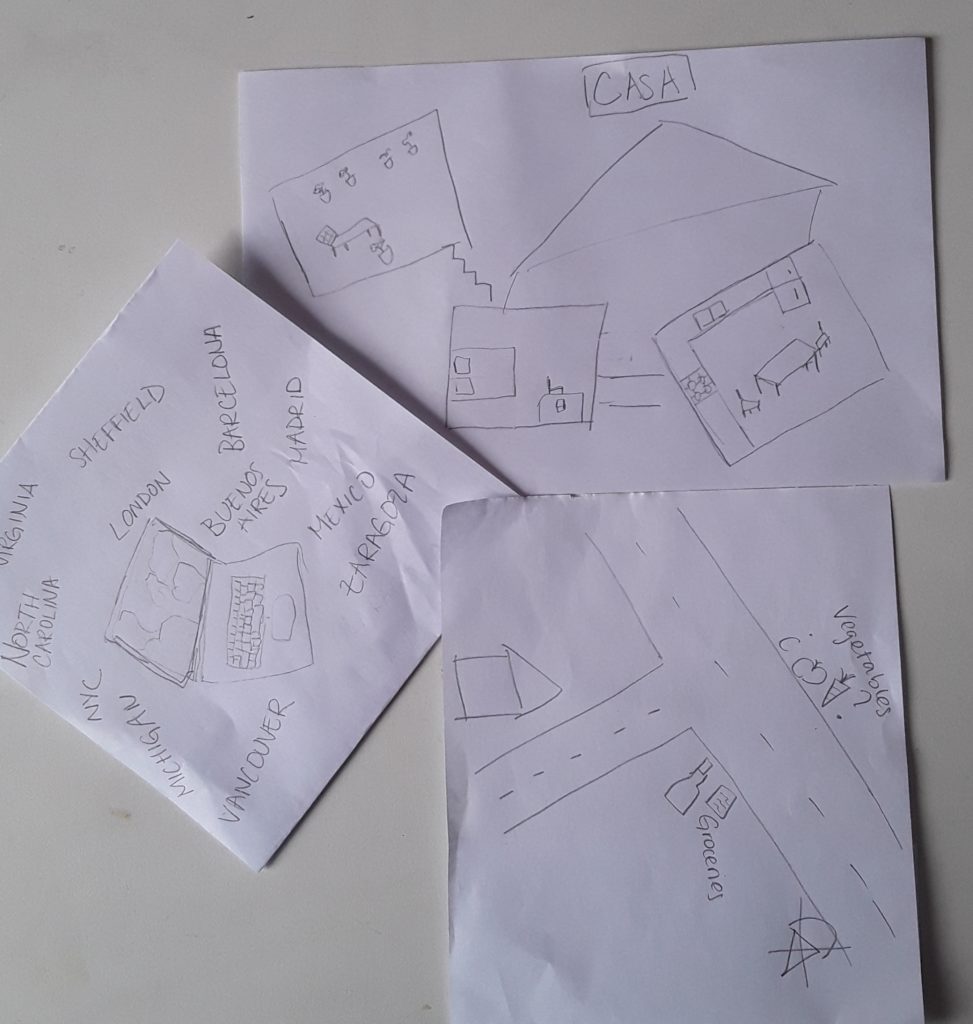
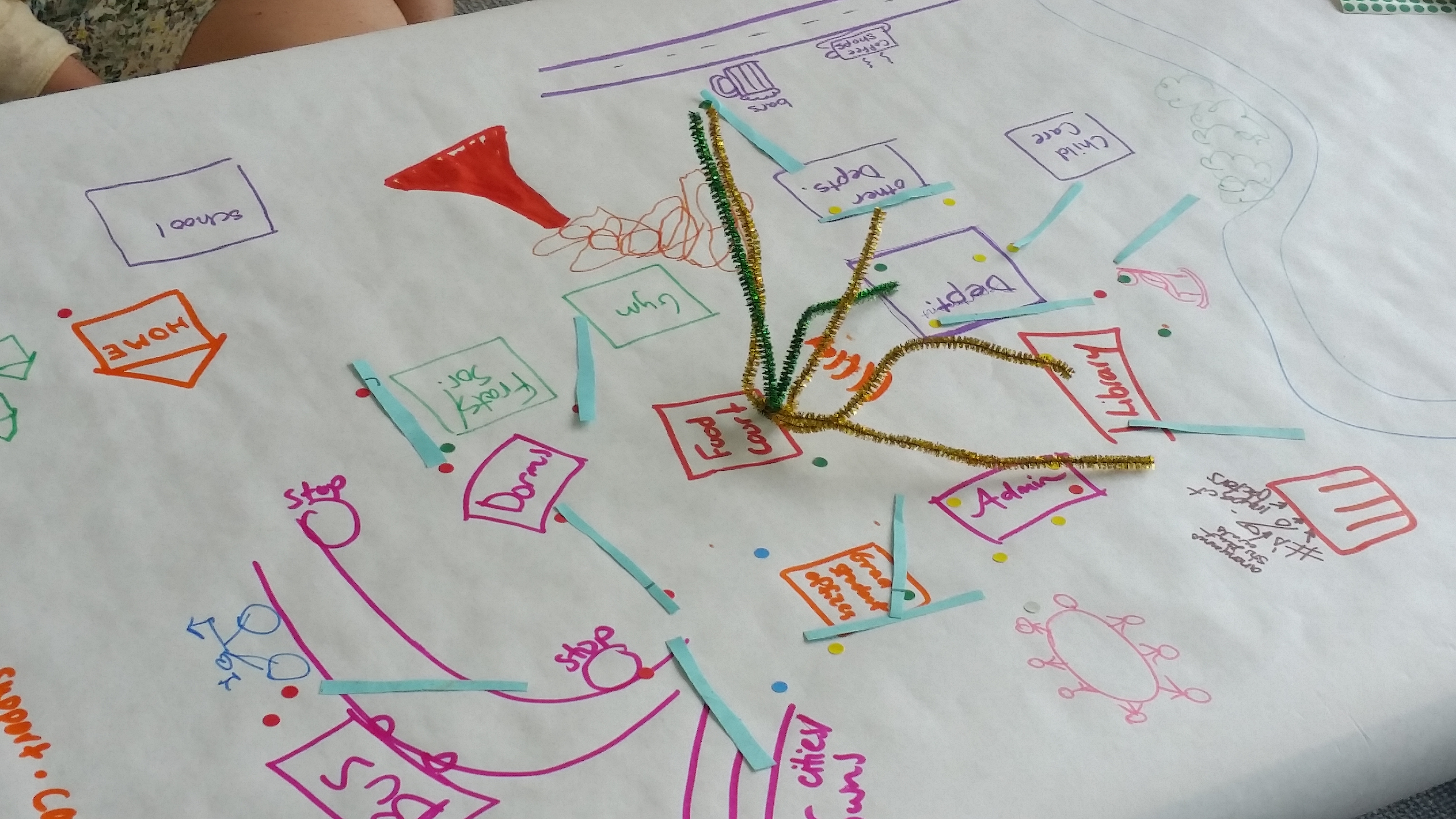
Before starting to post about getting to Madrid, we got inspired by the notes on 3Cs blog about our discussion/drift in Open Eye Café on spaces of labor/no labor on Sunday. We would like to contribute to our note taking enterprise with what we remember from the last bits of our conversation with Maggie: the Step-by-Step guidelines for drifting & mapping discussion @ Weaver St. Market. We are paraphrasing because we took mental notes, apologies in case we don’t remember well… -But really, how did Precarias a la Deriva go about doing, performing, making, putting together a drift? It is not so obvious when you really want to engage in drifting ‘a la precarias’ … -It is a long, but at the same time, expectable process…first, a deriva/drift makes no sense if there are not previous discussions on the main themes the group is concerned about and wants to start investigating in a collective way. From a series of group discussions, a set of thematic axes comes up as guidelines for the drifts. A couple of people linked to a particular axe, volunteer to organize one drift. These people know about that particular topic well because of personal experience –working in that sector for example- and have quite a few contacts. These point people strategize an itinerary identifying places that would speak to the issue in question, also contacting other possible participants that could also be interviewed/have a taped conversation with during the drift. That previous work is essential in order for the drift to work and be worthwhile. Then the rest is more or less explained in our different texts. Basically a group of people with note-taking equipment engage in an itinerary guided by a couple of guides who are experts in those spaces, those particular routines, that concrete sector. After visiting places, and having conversations within those locations and also in transition from place to place, each participant goes back ‘home’ and starts writing about the drift: being descriptive, emotional, reflexive, etc depending on the mood. Then all the texts are shared and collaged. -Drifting feels like mapping, isn’t it? And actually your book includes some cartographic representations of 3 particular drifts? Did you ever follow that path as a venue for your militant research project? Yes, and actually the precarias research project started as a mapping project. we wanted to document the different everyday itineraries of women workers to put together another vision of the city of Madrid. But it did not work, logistically but also conceptually: all that colorful drawing somehow did not work, the message that came across was not so powerful, and it really did not provided ways of collective organizing. We found out that the idea of actually performing the itineraries together and talking on the way, on the move, allowed for much more powerful communication and mutual understanding developing a sense for commonality and at the same time a sensitivity for diverse particularities. -So it was a kind of mapping 1 to 1 scale, right? That’s what we are thinking for the mapping the university project…[tim and liz replied]. TO BE CONTINUED in future conversations….
sebastian+maribel (+little gabriel) here starting the communication from mayrit.
The first post from madrid is related to the housing situation in spain. This may not be as acute an issue in other countries of the European Union, but urban development is a big deal currently in spain. Just to give you an idea, the EU cannot complete the Kyoto protocol on C02 emissions because of the cement production that is used for construction in spain.
Despite these high rates in housing construction, the lack of access to housing is one of the most striking in Spain’s recent history [and has actually been denounced by a UN representative on housing]. Young people with precarious labor situations are suffering these current contradictions the most.
In our apartment search in madrid we (slightly) lived through that stressful situation during several months of search, first via internet, and then, in situ. . The prices are amazingly high, and not only that, everything is rented within what can seem like seconds of posting a “for rent” add in the local newspaper or the major internet renting sites. After identifying the affordable and convenient ones at 7am when the newspapers go out, the round of calls started. Many of them started up by saying: Ya esta alquilado! It is already rented.
A call for a seminar/intercambio with participants involved in political art, collaborative and cooperative artistic practices, and creative political collectives from diverse sites from two continents…
If there is something to be highlighted in the current protest cycle (which, in a few strokes of the pen, has periods of maximum visibility such as the arc stretching from Seattle to Genova or the world demonstration against the Iraq war, founding moments such as the Zapatista uprising in 1994, effects on a macropolitical scale such as the processes of institutional change in Latin America, etc.) it is definitely the way in which innovation is a structural feature of the new forms of political action and construction which are at the base of that cycle. In recent years there seems to have been a confirmation of the image of the machine Guattari and Deleuze used to refer to the need for open, flexible forms for political creativity, for which the molar and molecular, micro and macro dimensions of politics, could cease, as they have done at other moments, to be mutually exclusive.
To simplify, notions such as machine or political creation allow us to mark out a territory from where we can radically rethink the relation between art, communication and politics, put into practice now as overlapping or interlinked components, avoiding the classic game of addition: art ‘plus’ politics, politics ‘plus’ art, politics ‘plus’ communication. For at least a decade we have been accumulating experiences which have occurred in every corner of the planet, practices quite distinct from one another which have not and will not multiply unless we think of them as genetically involved in the global protest cycle in progress.
In Sydney, Buenos Aires, Moscow, Kassel, Berlin, Havana … they are taking place, with diverse magnitude and fortune, activities with institutional visibility with new practices of political art that differentiate substantially from their replicas enclosed in the contemporary international art circuit. For the mentioned institutional moments are only flashes, although descriptive, points in a continuum that flows many times completely outside, sometimes between inside and outside of the artistic and social institutions. Someone has called these other practices “dark matter”: like the matter that, despite constituting the majority of the weight of the firmament and having a decisive influence on the evolution of the visible universe, remains to a large part hidden. It operates tirelessly between visibility and invisibility; it flows between different constitutions and forms.
This seminar looks to find similarities and differences between some concrete and recent cases of this dark matter. The central question that we propose is the following: with what forms, modes and tools these modest flexible machines are equipped, for which there is no radical politics without creativity in practices, without permanent invention in the forms and modes of construction of the self.
Máquinas
Un pequeño seminario informativo, didáctico y de intercambio con participantes en grupos de arte político, prácticas artísticas colaborativas y cooperativas, colectivos políticos creativos de diversos lugares en dos continentes.
Fechas: Martes 20 y miércoles 21 de febrero de 2007.
Lugar: Aula 1 del Museu d’Art Contemporani de Barcelona (Macba).
Horario: 17h-21h. Entrada libre.
Algunos nombres participantes en el seminario (y grupos y experiencias en las que toman parte): Daniel Lima y Joana Zatz de São Paulo (Contra Filé, Frente 3 de Fevereiro, A Revolução Não Será Televisionada, Política do Impossível), Juan Manuel Díaz y Verónica Iglesia de Buenos Aires (La Comunitaria TV), Loreto Garín de Buenos Aires (Etcétera, Internacional Errorista), Natasa Ilic de Zabreb (What How & for Whom [WHW]), Branka Ćurčić de Novi Sad (Kuda.org), Pilar Monsell y Javier Toret de Málaga y Sevilla (Centro Social Casa de Iniciativas, Entránsito, Otramálaga, Fadaiat, Indymedia Estrecho), Gerald Raunig de Viena (eipcp, transform), Ateneu Candela de Terrassa, Oficinas de Derechos Sociales (ODS), etc.
Si hay algo a reseñar en el actual ciclo de protesta (que, por describirlo a vuelapluma, tiene periodos de máxima visibilidad como el arco comprendido entre Seattle y Génova o la manifestación mundial contra la guerra de Irak, momentos fundacionales como la insurrección zapatista de 1994, efectos a escala macropolítica como los procesos de cambio institucional en América Latina, etc.) es seguramente la manera en que la innovación constituye una característica estructural de las nuevas formas de acción y construcción política que están en la base de dicho ciclo. Pareciera darse en estos años una verificación de la imagen de la máquina que Guattari y Deleuze utilizaron para denominar la necesidad de formas organizativas abiertas y flexibles para la creatividad política, para las cuales las dimensiones molar y molecular, micro y macro de la política, pudieran dejar de ser, como en otros momentos lo han sido, mutuamente excluyentes.
Dicho simplificadamente, nociones como máquina o creación política nos permiten acotar un territorio desde el que pensar de una manera radicalmente novedosa la relación entre arte, comunicación y política, puestas en práctica ahora como componentes entre sí imbricadas o concatenadas, sorteando el clásico juego de sumas: arte “más” política, política “más” arte, política “más” comunicación. Desde hace al menos una década acumulamos experiencias, que se han dado en todas las partes del planeta, de prácticas muy heterogéneas entre sí cuya multiplicación no ha podido ni podrá darse si no es pensándolas como genéticamente imbricadas en el ciclo de protesta global en curso.
En Sydney (http://www.ifyouseesomethingsaysomething.net), Buenos Aires (http://www.exargentina.org/participantes.html), Moscú (http://transform.eipcp.net/calendar/1153261452), Kassel (http://www.fridericianum-kassel.de/ausst/ausst-kollektiv.html#interfunktionen_english), Berlín (http://www.klartext-konferenz.net/home.html), La Habana (http://www.bienalhabana.cult.cu/protagonicas/proyectos/proyecto.php?idb=9&&idpy=23)… se suceden, con diversa magnitud y fortuna, actividades de visibilidad institucional de nuevas prácticas de arte político que se diferencian sustancialmente de sus réplicas encerradas en el circuito internacional del arte contemporáneo. Pero los momentos institucionales mencionados son sólo fogonazos, aunque reseñables, puntuales en un continuo que fluye muchas veces totalmente fuera, a veces entre el adentro y el afuera de las instituciones artísticas y sociales. Alguien ha llamado a estas otras prácticas “materia oscura”: como la materia que, no obstante constituir la mayor parte del peso del firmamento y tener una influencia decisiva en la evolución del universo visible, permanece a grandes rasgos oculta. Opera incansable entre la visibilidad y la invisibilidad; fluye entre diferentes constituciones y formas.
Este seminario busca poner en común y contrastar algunos casos concretos y recientes de esta materia oscura. La pregunta central que proponemos es la siguiente: de qué formas, modos y herramientas se dotan algunas de esas modestas máquinas flexibles para la cuales no hay política radical sin creatividad en las prácticas, sin invención permanente en las formas y en los modos de construcción de sí.
Esta actividad se piensa en continuidad con dos realizadas el pasado año: los seminarios Otra relacionalidad (2ª parte) (http://www.macba.es/controller.php?p_action=show_page&pagina_id=33&inst_id=21017) y Capitalismo, fuerza de trabajo, política, movimientos antisistémicos (http://www.macba.es/controller.php?p_action=show_page&pagina_id=33&inst_id=21872); está vinculada también con el área Imaginación política del Programa de Estudios Independientes (PEI) del Macba. Organizada en colaboración con Brumaria (http://brumaria.net/publicacionbru7.htm).
Algunos enlaces:
Gerald Raunig: “Algunos fragmentos sobre las máquinas”
http://transform.eipcp.net/transversal/1106/raunig/es
Gregory Sholette: “Dark Matter: Activist Art and the Counter-Public Sphere”
http://gregorysholette.com/essays/docs/05_darkmattertwo.pdf
Javier Toret y Nicolás Sguiglia: “Cartografía y máquina de guerra”
http://transform.eipcp.net/transversal/0406/tsg/es
3Cs_Maribel Casas-Cortés y Sebastián Cobarrubias:
“A la deriva por los circuitos de la máquina cognitiva”
http://brumaria.net/publicacionbru7.htm
Amador Fernández-Savater, Marta Malo de Molina, Marisa Pérez Colina, Raúl Sánchez Cedillo: “Ingredientes de una onda global”
http://www.arteleku.net/4.0/pdfs/1969-2bis.pdf
Marcelo Expósito: “La imaginación política radical. El arte, entre la ejecución virtuosa y las nuevas clases de luchas”
http://www.arteleku.net/4.0/pdfs/1969-1.pdf
Etcétera + Internacional Errorista
http://transform.eipcp.net/correspondence/1170076372
http://pr.indymedia.org/news/2005/11/11108.php
http://argentina.indymedia.org/news/2006/12/475515.php
La Comunitaria TV
http://www.vive.gob.ve/archivos/videos/ns_diadelnino.swf
http://argentina.indymedia.org/news/2005/02/263804.php
The encounter among different art/mapping collectives at the MACBA (Museum of Contemporary Art of Barcelona was just fantastic. Each group introduced its work, shared its materials and linked it to issues of security and public space.
Arriving in Madrid at the end of January was quite chaotic, not only with the baby and moving into a new house- but also the need to register a series of papers and bureaucracies that one needs when arriving in a new country… medical ids, citizenship/residence papers (when possible), registering ourselves with the municipality, and other stuff like hat. All of this implies waiting in colas/lines…
What was interesting to see, was that in most of the lines (some of which were quite long) that vast majority of fellow “waiters” were what would be called in ugly sounding legal language as “extra-communitarians” in other words immigrants from non-EU countries. Everyday- dozens or hundreds of people processing residence papers, renewing permits, registering themselves at the municipality, processing health ID cards, etc. all at offices that are still to a large degree adjusting to what for them are new populations.
The immigration “question” is seen as something quite new here, and although one might be bale to find some longer history to it, the dynamics and population shifts tis is producing are quite radical and all happening very fast. To give a statistical example:
According to the INE (national institute for statistics) In 2000 the migrant population (including EU and extra communitarian) was 2.3% of the whole population, roughly. In 2006- this jumped to 10+% (these numbers don’t include estimates of sin-papeles/undocumented). This might reflect that the authorities are getting better at counting- but there is definitely some truth to the idea of a radical change. Spain a country which always considered itself as “homogeneous” (often ignoring other minorities such as gypsy/roma, basques, catalans, castilians, asturians, and other linguistic groups) was now being reworked by very visible forms of diversity. On the one hand the perceived newness seems to lead to a certain innocence via a vis the situation and without the long histories of slavery and exclusion that have rocked the Americas for so long- for example new marriage statistics point to the fact that somewhere between 10-30% of new marriages are between “national” and “immigrant” (problematic categories to begin with- but we’ll leave that aside). On the other hand there’s a lack of awareness of forms of racism and exclusion that are rearing their heads- from racist sounding comments being said openly (“aren’t there any Spaniards here” or “well, that part of town, you know has lots of those people…from outside”)- to anti-immigrant pogroms or attacks.
Waiting on these lines, in places were few if any “nationals” need to wait- we got to hear some of the comments people (“immigrants”) would make to each other about their perceptions of the situations, stuff like: “we’re paying their social security pensions, and taking care of their elderly and they treat us like crap!” “these people won’t do any work and then they complain about us who have to suffer through this treatment!” “we” are always renewing papers here, filing something there…”
The way that immigration has jumped into prime focus and has burst onto the scene is incredible- nad the newness (perceived or real) of the issue is palpable. It can go in many ways for the moment it seems. From greater awareness form the get go about the need to avoid segregation, supremacy and discrimination- to the increasing militarization for the border on the part of the whole EU resulting in a militarization of the immigration question (like what many u.s. republicans are pushing on the border with mexico).
We’re keeping our ears open- and we’ll be sure to get involved in as many political messes as we can- to see how this all works out. Just for some other fun fact related to this: 1) the other week when that neighborhood housing rights group was preparing to do an action in the Lavapies barrio (where we live) they talked about producing flyers in multiple languages. Well if in the US, its already an achievement to have it in Spanish- this group- for all its faults- was able in less than a week to print an distribute flyers in Spanish, French, Arabic, English and Chinese!!! 2) There’s all sorts of migrant rights/anti-racist stuff that is beginning to happen including lots of self-organization by migrant communities, just the other week there was a protest by our house by a sort of independent migrant workers’ union, and today we met one of the main dudes in African liberation/panafricansim in Madrid (who named his son Malcolm X!)
Well there are many thing we miss about Chapel Hill & NC (mostly you folks and other friends of course) or about the US, but there are some things that just can’t compare! Its our first time back in a big city after a while- and phew!! What a change in scale- and like ecologies of space or something like that- just a totally different way to inhabit an area. We miss all the trees, but instead of having to walk 40 minutes to get our bread we have like 3 fresh bakeries within two blocks walking distance form our house!! We can walk to the doctors and pediatrician!
There are cool places to get coffee all over- on EVERY STREET!!! Plus the streets are windy- so you can randomly pick one and just get taken along…you can get lost or find yourself at home by accident! We have great food nearby, bookstores, nearby- and what do you know…protests & pickets!! Instead of car pooling to a meeting in one place and then getting into a car again to go to an action or something…here there are marches just passing by our window. For example just this past month and only including those that passed by/near our house or that we ran into while taking the baby for a stroll or something: Union pickets At two different stores over working conditions, back pay, etc.; an anarcho-syndicalist march against labor accidents; a migrant rights/anti-racist march organized by immigrant organizations; the two large unions marching for better public services- this is all stuff we had little (or no) idea of. Or another example: this weekend- just within our neighborhood or immediately adjacent: a two-day event/ encounter on precarity issues and struggles (two block from house); protest march against parking meters in poorer neighborhoods (??-apparently an issues that has blown up in the past year- a few blocks away); urban eco-agriculture and CSA fest at a squatted social center; another social center that is moving locations with a bunch of activities around that; and of course people getting together to get ready for march 8th- international women’s day. That’s all just in the neighborhood..!
Anyway- no need to over idealize- nothing is ever as it sounds and this neighborhood might just be a quite special one- but anyway we thought it kind of interesting and cool. You’ll all have to come visit soon!
Machines is the name given to a unique encounter for sharing experiences among creative activist collectives from diverse sites along the Atlantic. This workshop-reflection event took place at the Museum of Contemporary Art of Barcelona (MACBA) during February 18 and 19, 2007. As the call to this encounter reads, the given name is not arbitrary but captures a kind of common political ground among the participants:
“If there is something to be highlighted in the current protest cycle [ ], it is definitely the way in which innovation is a structural feature of the new forms of political action [ ]. In recent years there seems to have been a confirmation of the image of the machine Guattari and Deleuze used to refer to the need for open, flexible forms for political creativity, for which the molar and molecular, micro and macro dimensions of politics, could cease, as they have done at other moments, to be mutually exclusive.
To simplify, notions such as machine or political creation allow us to mark out a territory from where we can radically rethink the relation between art, communication and politics, put into practice now as overlapping or interlinked components, avoiding the classic game of addition: art ‘plus’ politics, politics ‘plus’ art, politics ‘plus’ communication. For at least a decade we have been accumulating experiences which have occurred in every corner of the planet, practices quite distinct from one another which have not and will not multiply unless we think of them as genetically involved in the global protest cycle in progress”.
As the call to the two day seminar suggests, the groups involved seemed to embody the notion of war machine in their practice. Tools, concepts, objects (such as maps, artistic interventions outside/within artistic institutions, actions) are used to concatenate various social actors and forms into a complex body of movement and action. Although sharing the use of a particular machinic object, these same actors and forms are not structured by it in any fixed sense. The “machines” used by these groups are precisely to open up/break apart the striated structurations of particular concepts used by the state or particular institutions that order behavior, action and knowledge. In the case of the first day’s groups- there is an attempt to crack open the notions of security currently deployed in modes of governance and for the second day’s groups what qualifies as public space -or even as a ‘public’- is challenged through social action. The fixity of these notions is traversed or broken up to open new possibilities for intervention and new ways of ‘being’ in common (see Gerald Rausig 2005)[1].
The two-day encounter was divided by transversal themes. Instead of limiting the sessions solely to self-referential presentations by each group, each day was organized around a series of shared issues. During the first day, a set of groups focused on how their own projects dealt with the questions of i) security, ii) policies of criminalization and control, and iii) non-regulated education to combat those. The groups of the second day discussed i) how their projects problematize the production of public space, how is it constructed, how is it subverted and intervened in? as well as ii) the relationship between struggles and institutions.
Day 1: The two groups from Buenos Aires shared a humoristic take on the question of security that has gripped the country in recent years. Subverting the media generated fear, TV Comunitaria presented “El Segurisimo”, a mock TV commercial selling personalized cages readily delivered with a cell phone call at any time in order to surround and protect you at all times from “others” –street criminals and radical militants- around. The Etcétera Collective presented the “Internacional Errorista”. Armed with cardboard Kalashnikovs, pistols and RPG’s; masked with make believe kuffiyahs, the “errosrits” assumed all stereotypes and mediatized images of terrorists during the actions against the summit of the FTAA as a way to defuse the tensions around anti-terrorist security laws. The projects from Sao Paolo - Contra Filé and Frente 3 de Fevereiro- focused on questioning different aspects of the control society, playing with mass media attention and assuming its unknown consequences. One of the projects, “La Catraca”, popularized the concept of control in everyday life through the image of a turnstyle, after stealing one of those and placing it as a public monument in a square, the media invented a verb to refer to this concept. This new word-image became popular and even appropriated by different Brazilian social movements dealing with issues of privatization and free access to public transport. The collective based in Andalucia –Hackitectura- presented a cartography of the Spain-Moroccan border, visually showing the increasing militarization, survey technologies and control mechanisms placed at the contours of the currently being produced Fortress Europe. This map also showed the different sites of resistance to that security paranoia showing the density of networking among social movements among the two sea sides.
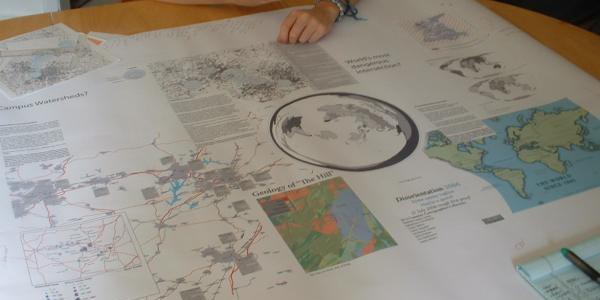
Day 2: Thinking through the production of space issue, the North Carolina based group -3Cs Counter Cartographies Collective- focused on how the American university is usually constructed as a discrete bubble distanced from reality and thus politics as well. Trying to subvert this spatial thinking, the 3Cs put together a “DisOrientation Guide” that portrays the university as a factory, as well as a material body, part of a mapped dense network of social, ecological, racial relations within the knowledge economy. In a different venue, the art collective from Zagreb -What, How & For Whom- approached the issue by looking at the tensions of public/private space in a post-socialist country through different art works and exhibitions. For example, through a photographic montage focusing on the body as a political actor as well as exhibitions such as “Normalization” and “Alternative monuments to Tesla”, they are trying to contribute, and constitute in themselves, different notions of public space. Kuda (Novi Sad) ____________________________________________???. Finally, Ateneu Candela based in Terrasa talked about the “Oficinas de Derchos Sociales” [Offices of Social Rights] as a way to rearticulate previous struggles over urban space, looking towards the creation of a kind of alternative institution focused on emerging figures such as the precarious, migrant and cognitarian workers, as well as those suffering from ‘real state violence’ and other issues related to precarity. The goal being to reinvent a public space able to put in common the diverse subjectivities in struggle.
This kind of encounter –besides debates over within/without institutions- provides a temporary space for mutual infection where the different projects create resonances with each other, coming back to the distinct locations with eagerness to hack, assemble and reinvent new strategies in diverse territories. According to some of the participants, these encounters are not to be understood as an end in itself, but rather as part of a process of exchanging tools, strengthening networks and multiplying parallel projects for social struggles everywhere. [the above part of this post will be published at transform ]
One thing that curiously came to the fore across both days was the use several groups were making of cartography. Though maybe this grabbed our attention since we’re part of a cartographic collective (he he). Out of the eight or so presentations and the different groups represented, at least three or four were using or discussing the use of cartography as a tool in strengthening or opening struggles over spaces. Either as a way to demystify or challenge particular notions of a space (such as the Border or the University) or to suggest new uses for spaces (signaling empty houses in a gentrifying neighborhood for occupation/squatting…). Cartography became a way to present and distribute analyses in a non-textual format with the goal of broadening the audience as well as a way of moving beyond the singular performance or graphic representation of a situation into a piece that could travel on its own carrying many messages in its framework.
Some details on the cartography question:
Hacktiectura and the Malaguenos
Through this encounter we were able to meet some of the folks involved in the Hackitectura project face to face. This was a real treat since we’ve been mulling over their work (both personally and collectively with 3Cs) for quite some time, and they’d been an inspiration for much of what we’ve been doing recently…
Just a few notes of some of the things they said either in conversation or in the presentation which could be relevant:
-The choice of mapping due to its non-textual form of communication, which for them allowed the conveying of more concepts and more complex ones in less space than a text and without the same thickness of having to “read through” something. We learned how much the “Cartografia del Estrecho” the Map of the Straits of Gibraltar has been circulating in Spain. At least among social movements it has become something rather referential.
They also explained the Otra Malaga project (which we haven’t jumped into as much yet though we recently received the first copy- one going to 3Cs soon too we hope). The Malaga Social Forum was to occur soon, and with this excuse they began a participatory action research project that in some sense surveyed the different struggles across the province. They would meet with activists involved in different fights (primarily ecological, precarious labor and migrant rights) hold conversations, interviews, snowball to other contacts, produce video- photos etc. in order to produce a dense sort of “Situation Report” on what are the issues facing the province, who are the collectives facing them and what strategies they are using–; more importantly what sorts of overlap are there-or might there be between different struggles (either in proximity or other connections as in a particular corporation, what have you…). For the final results a map of the “Other Malaga” was produced that drew attention to the situation of and interconnections between migratory flows, new labor conditions, and the macro-tourist development going on in the area (lots of new golf courses for example)- in addition there was a DVD and a small book that traced the results of the work- all released to coincide with and intervene in the Malaga Social Forum.
What we realized after speaking with them a bit more is that these mapping and research projects (i.e. the straits and otra Malaga) were not just random interventions but part of a years-long effort to articulate social movement efforts across Andalucia- especially those dealing with questions of precarity and global resistance. The result for the moment seems to be quite a tight network of groups and individuals that are increasingly able to take on larger/more complex projects and mobilize more people. There’s even a sort of joke we heard called the “Malagueno school of organizing” with its own sorts of strategies, focus on efficiency and other such things. Curious how the mapping efforts may have played a rol in tying parts of that network together.
The Brasilians:
We had quite a long conversation with a member of the Frente 3 de Fevereiro on the uses of mapping which is a direction their collective is moving towards. This group had done different sorts of stuff- very interesting interventions-, including working indirectly with the fear generated around the PCC (the group that in the past year turned super violent in Sao Paolo but has its origins as an anti-capitalist prisoners’ movement) and an intervention that created a new vocabulary word that sort of translates as “turnstile-ization” as in the placement of instruments that define who can access something or not- additionally creating a set of imagery with actual turnstyles that have been usede frequently by media, academics, and social movments in Brasil in the past two years (especially the student movement and the Passe Livre movement [free transport for school kids]) which has included bringing turnstyles to marches and burning them. Anyway, that’s some background on them. We hope to exchange notes with them about the conversation and mapping in general- and they were very excited about some of 3C’s stuff- (I think they were flipping the idea of inviting someone over to Brasil or at least asking form materials!!!….Caipirinha anyone!?)
We started talking about the possibilities and limits of 2-D mapping and how to move beyond it. In particular how to produce a map that would function from the viewpoint of someone walking around- as opposed to the bird’s eye view maps normally take. We chatted briefly about GIS programs that can take the geo-referenced material and with a graphics program (or maybe a CAD program?) translate some of the info into a virtual 3-D model- sort of a virtual tour. But quickly we moved onto some other issues- one thing they’ve been discussing is a concept called the “corpo-vibrator” or something like that- we’ll check again soon. Apparently (if we’re not getting things confused between the castillian and the Portuguese) this is a concept written about by Suely Rolnick- a brasilian psychologist that worked with Guattari- and it refers to the body and how its is impacted by certain sorts of feelings or emotions linked to an action or space- not so much a memory or a though tout reaction as an almost visceral one. So the notion was sort of how to produce maps that could provoke emotions/gut reactions- something to that extent, and not only the sorts of cool analysis and discussions we usually have around a table with a map on it. Ideally combining this corp-vibrator map with one of these non-2D itinerant’s perspective maps.
We shared the idea (Liz, Tim,…any news here) about the 1-1 map that we had discussed in 3C’s and the story of the short story by Borges and how Baudrillard uses it. Would this be similar to a tourist map that then has referents to the map in the street (as in little “ i ” signs that signify information or icons that represent sites of interest)? Could we create a logo on a map that could then be used as a logo in the street?
He then briefly presented an idea they were playing around with (roughly similar to a strategy mentioned around the Wicked Burrito discussion a year or two ago) which was a strategy to fight rampant gentrification in Sao Paulo. To survey social movements, squatters, NGOs etc. about vacant buildings, and create a sort of logo/graffiti that symbolized “vacant building. Creating a map of these buildings, that between all the different actos, would end up being quite an impressive number of buildings that used this logo.
Then starting to tag buildings with this logo in the street- such that you could use both the map and the tags to discover these places. This could serve as a tool for what he was telling us are some of the massive Sem Teito (Homeless) movements in the city that could use the map and compiled info as a tool to denounce urban speculation or directly to squat vacant buildings
Anyway those are some of the notes on mapping, political uses of cartography and research from the discussions and presentations there in Barcelona- just to add to the short sum up of the conference there. We learned a lot, we hope y’all like it too.
PS. More details on the two Argentinian collectives as well:
TV Comunitaria- Buenos Aires started off by presenting their intervention into the personal security craze that is throttling Argentina. An intense fear is being inculcated in many parts of the Argentine population through the salience given to news of rising street crime (perceived or real) and the danger of certain types of protesters as well. The message seems to be that one should fear the “street” as a space, that one is only safe if one looks after themselves and takes measures. Faced with this TV Comunitaria produced “El Segurisimo”, a mock TV commercial which attempts to face people with the ridiculous conclusions of this security craze: in this case personalized cages that can be purchased in order to surround and protect you at all times from “others” around. If need by the cages can be readily delivered with a call from your cell phone so you can instantly isolate yourself form the street and potential threats that –of course- are everywhere.
The Etcétera collective, from Buenos Aires, presented the “Internacional Errorista”. Just prior to the latest Summit of the Americas (FOOTNOTE where the Free Trade Area of the Americas is discussed by government and corporate interest from throughout the continent) in Fall 2005 which was set to take place in Mar del Plata Argentina, a series of anti-terrorist legislations were passed in Argentina. The legislation was vague enough that many activist or militant practices could be considered “terrorist” and the legislation appeared as a means for the government to take advantage of the climate of the “Global War on Terror” in order to crimilanize some elements of social movement in the country (especially some sectors of the unemployed workers movement). In addition the media filled Argentine press with stoire and rumore of thousand of body bags being shipped to Argentina in case there was a “terrorist attack” during the summit. The Errorist International responded to the craze. Armed with cardboard Kalashnikovs, pistols and RPG’s; masked with make believe kuffiyahs and defining their movement as one of “errorism”, the Errorists took over avenues in Buenos Aires (looking strangely like a commando from the PFLP), marched against the FTAA, and infiltrated a beach in Mar del Plata that was within the security zone, thus looking as if a group of terrorists was launching an amphibious assault! All stereotypes and mediatized images of terrorists were fully assumed by the “errosrits” as way to defuse the tensions and fear around anti-terrorist security and to shove the debate about new security measures into public light.
[1] The presentation on Machines by Gerald Raunig was not publicly delivered, though copies of his paper were widely distributed during the seminar.
We already commented on the difficulty of finding an apartment for rent in Madrid. The prices have sky-rocketed repeatedly in recent years. There’s a ton of financial speculation going on and a lot of it is tied in with politicians trying to make a buck off of gentrification- thus the politicians will help change zoning laws or the qualification of lands (as in from “industrial land” to “urbanizable land”) to build luxury apartments. In the last post on this we mentioned how this is leading to a huge degree of inaccessibility of housing especially for young folks facing precarious labor conditions. The UN commissioner on housing, in a recent trip to Spain actually denounced the situation and the degree of urban speculation.
There are a whole series of factors going in to this situation. We don’t know enough yet to explain in any detail- a lot of factors tie in- including the change to the Euro, the freeing up of real estate markets, the very thin market for renting apartments, local political corruption, etc. All this has resulted in some very weird factors such as: this generation in Spain is the one that will take the longest to be able to leave their parents’ house (partly due to these high housing costs and temp jobs, thus you see 30-somethings living at their parents’ place- couples putting marriages and children on hold, etc.- thought this isn’t only b/c of the housing situation it is exacerbating it). Also, apparently Spain (or maybe its specifically Madrid) currently has the most expensive housing costs as compared to local salaries in the world second only to Japan (or maybe just Tokyo- we’ll try and verify)- i.e. the percentage of earnings being destined to mortgage payments, rent, etc.
In the past year this situation has given rise to a very interesting movement for access to housing. Although it is becoming increasingly complex and many actors are getting involved what is interesting is the spontaneity of the movement’s emergence. Rather than particular organizations, unions, community groups, well-defined activist networks taking on the issue- it was much more informal in its beginnings. Most people seem to define it as coming from a series of discussions in internet chat rooms, SMS messages, and blog posts. Several sit-ins were called for and grew in size regularly leading to the formation of the Assembly against Precarity and for Housing with Dignity (another large platform is called just Housing with Dignity but this made up much more of already pre-defined social movement and community groups).
Many who began participating here are not life-long militants but people who got active on this issue in particular. The other interesting factor is how precarity is tied in- both labor precarity but also what someone from the assembly mentioned as “precarity of rights” that is currently being forced on people.
Much of the movement has grabbed onto the “V” for vendetta symbol. The one from the blockbuster movie with a circled “V”. The movie’s logo has been appropriated by many in this city and you can see the graffiti all over our neighborhood. This is because the word for housing (vivienda) also starts with a V so the movement is sometimes referred to as the V for Vivienda movement. We’re attaching some photos here of the graffiti. Around carnival there were a bunch of folks (including us for a while) dressed up in the movie’s costumes as a way to get the word out about the housing movement. This March 24th there are going to be a series of national demonstrations about this issue. We’ll keep you posted.
P.S. please send word around about this movement- we’ve heard that folks here are looking to contact other housing rights groups internationally.
We’re including a link here that describes some more about the movement in English (has some errors, oh well) as well as couple of links to some of the platforms that are emerging